
Estimated reading time: 5 minutes
- What is shadow work?
- Why use tarot for shadow work?
- A gentle note before you begin
- The shadow work tarot spread (7 cards)
- Cards that often appear in shadow work
- Journaling prompts for shadow work
- A shorter 3-card shadow spread
- After your reading
- Frequently asked questions
- Meet yourself with kindness
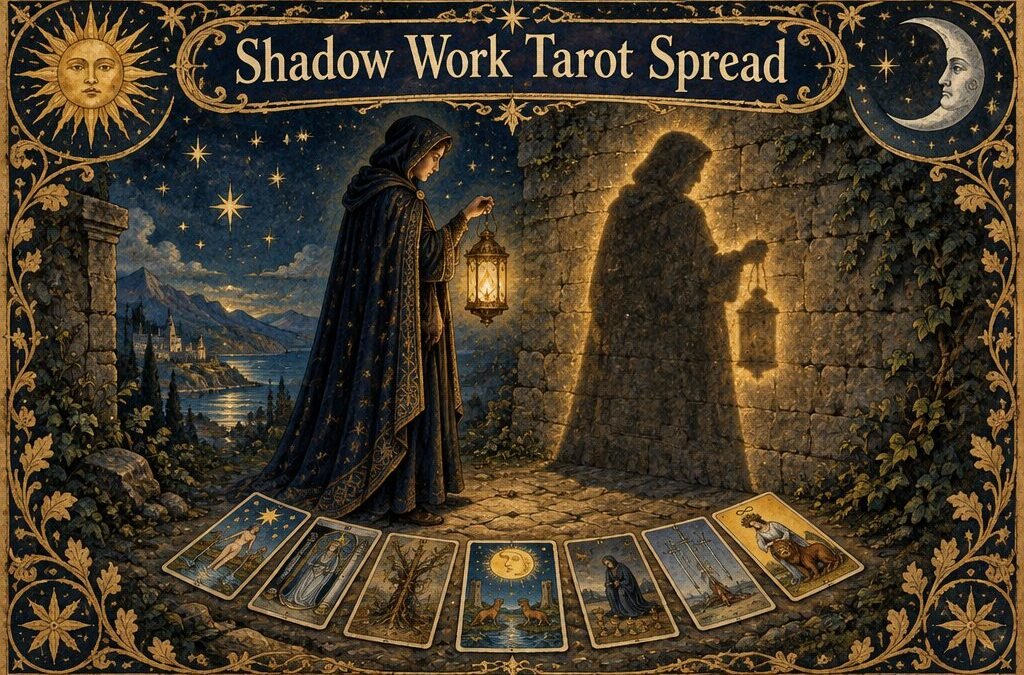
We all have parts of ourselves we would rather not look at: old hurts, jealousy, fear, the habits we repeat without knowing why. The psychologist Carl Jung called this hidden side "the shadow," and the process of gently bringing it into awareness is known as shadow work. Tarot, with its rich archetypes and honest imagery, is a natural tool for it. Below is a gentle seven-card shadow work tarot spread, journaling prompts to go with it, and guidance on doing shadow work safely and kindly.
What is shadow work?
The shadow is made up of the traits, feelings and memories we push out of sight, often because we learned early on that they were unacceptable. Anger, need, envy, grief and even talents can end up there. Hidden parts do not disappear: they show up as triggers, patterns and reactions that seem bigger than the situation.
Shadow work is the practice of noticing these patterns with curiosity instead of shame. The goal is not to "fix" yourself, but to understand and integrate all of who you are.
Why use tarot for shadow work?
- Archetypes. Tarot cards depict universal human experiences, making it easier to recognize your own.
- Distance. Talking about "the figure in the card" can feel safer than talking about yourself.
- Structure. A spread breaks a big inner process into manageable questions.
- Honesty. Challenging cards like The Devil or The Moon invite reflection on hard truths.
A gentle note before you begin
Shadow work can bring up painful memories. Go slowly and be kind to yourself.
- Choose a calm time when you are not rushed or already overwhelmed.
- Stop if you need to. You can return to a card later.
- Ground yourself afterwards with a walk, a warm drink or time with someone you trust.
- Seek support. Shadow work is not a substitute for therapy. If you are dealing with trauma, depression or anything that feels too heavy, a qualified therapist is the right guide.
The shadow work tarot spread (7 cards)
Lay the cards in a downward arc, like steps descending, with the last card rising back up.
| Position | Question |
|---|---|
| 1. My mask | How I present myself to the world |
| 2. My shadow | A part of myself I tend to hide or deny |
| 3. Where it came from | The root of this pattern |
| 4. How it shows up | Where this shadow appears in my life today |
| 5. What it protects | What this part of me has been trying to keep safe |
| 6. Its hidden gift | The strength within this shadow |
| 7. Integration | How to accept and work with this part of me |
How to read it
- Cards 1 and 2 often contrast. A confident Queen of Wands as the mask with a fearful Nine of Swords as the shadow shows how hard you may be working to seem fine.
- Card 3 points toward origins, but you do not need to dig into painful memories in detail. Notice, then move on.
- Card 5 is often the turning point. Many shadows formed to protect us; seeing that can soften self-judgment.
- Card 6 reminds you that every shadow holds something valuable: anger can become healthy boundaries; envy can reveal what you truly want.
- Card 7 is a gentle next step, not a demand to change overnight.
Cards that often appear in shadow work
- The Devil: attachments, compulsions, the chains we accept.
- The Moon: fears, illusions and the subconscious.
- The Tower: defenses breaking down so truth can emerge.
- Five of Cups: grief and regret that need acknowledging.
- Nine of Swords: anxiety and self-criticism.
- Strength: taming inner lions with compassion, the heart of shadow work.
These cards reflect the middle chapters of the Fool's Journey, where the traveler turns inward to face himself.
Journaling prompts for shadow work
Pair your spread with writing. Our guide to tarot journaling has more ideas.
- What emotion do I find hardest to feel or show?
- What trait in other people irritates me most, and where might it live in me?
- What did I learn as a child about being "good"?
- When do I feel most defensive, and what am I protecting?
- What would I do if I were not afraid of being judged?
- What part of myself have I been ignoring that deserves kindness?
- What strength might be hidden inside my biggest flaw?
A shorter 3-card shadow spread
- What am I hiding from myself?
- Why have I been hiding it?
- How can I embrace it with compassion?
You can draw these three cards in our free Three Card Tarot reading.
After your reading
- Close with gratitude. Thank yourself for your courage.
- Do something nurturing. Rest, eat well, move your body.
- Revisit gently. Look back at your notes in a week. Insights often deepen with time.
- Balance with lightness. Follow shadow work with a joyful activity or an uplifting reading.
Frequently asked questions
What is a shadow work tarot spread?
A shadow work tarot spread is a layout designed to explore the hidden parts of yourself (fears, patterns and suppressed feelings) with curiosity and compassion.
Is shadow work safe to do alone?
Gentle shadow work can be done alone, but go slowly and stop if you feel overwhelmed. For trauma or serious emotional difficulties, work with a qualified therapist.
Which tarot card represents the shadow self?
The Devil and The Moon are most often associated with the shadow self: The Devil with attachments and compulsions, The Moon with fears and the subconscious.
How often should I do shadow work?
There is no set schedule. Many people do a shadow work reading monthly, often around the waning or new moon, and give themselves time to integrate between sessions.
Meet yourself with kindness
Shadow work is not about finding what is wrong with you. It is about welcoming every part of you home. Lay out the seven cards slowly, write honestly, and remember that the light you carry is what makes the shadow visible. For a gentle counterbalance, try our free Daily Tarot for everyday encouragement.