
Estimated reading time: 5 minutes
- What you need
- The four ingredients of a birth chart
- Step 1: Start with your big three
- Step 2: Meet the planets
- Step 3: Read each planet's sign
- Step 4: Find the houses
- Step 5: Notice the aspects
- Step 6: Look for the big picture
- Putting it together: a simple method
- Birth charts, compatibility and tarot
- Frequently asked questions
- Start exploring
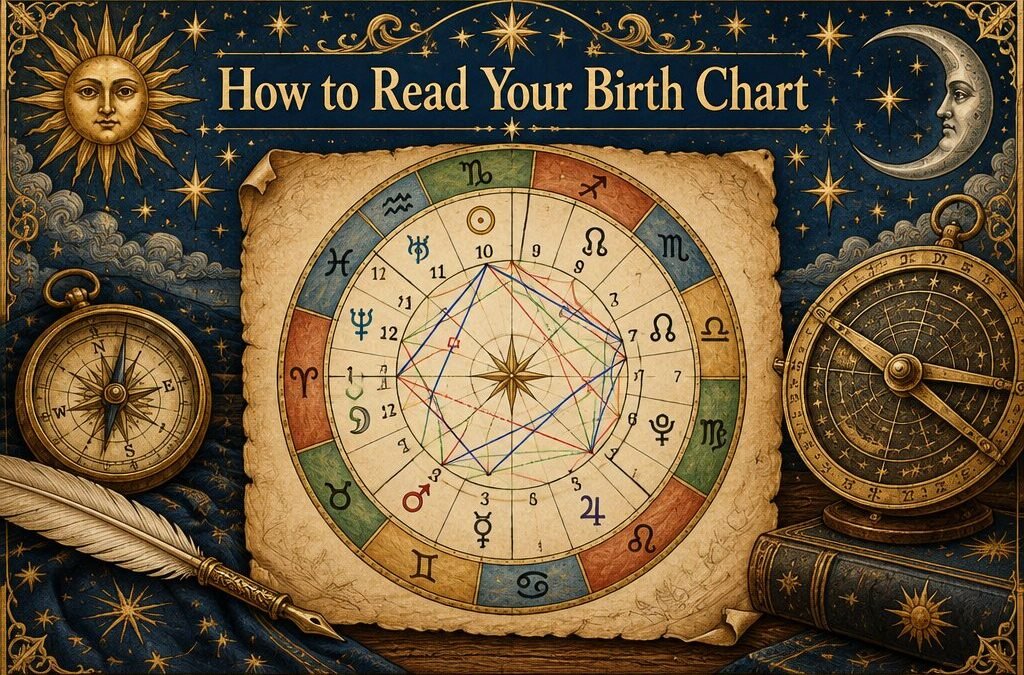
Your birth chart, also called a natal chart, is a map of the sky at the exact moment and place you were born. It shows where the sun, moon and planets were, which zodiac signs they occupied, and how they related to each other. Astrologers use it to explore personality, strengths, challenges and life themes. At first glance a chart looks like a confusing wheel of symbols, but it is built from four simple ingredients. This beginner's guide explains how to read your birth chart step by step.
What you need
To create your birth chart you need three pieces of information:
- Date of birth.
- Exact time of birth (from a birth certificate or family records if possible).
- Place of birth.
Enter them into any free online birth chart calculator. Without an exact time you can still read the planets in signs, but the houses and rising sign will be uncertain.
The four ingredients of a birth chart
Think of a chart as a sentence:
- Planets are the what: the different parts of you (your emotions, your drive, your communication style).
- Signs are the how: the style in which each planet expresses itself.
- Houses are the where: the area of life where that energy plays out.
- Aspects are the conversations: how the planets interact with each other.
So "Venus in Leo in the 7th house" might read as: your way of loving (Venus) is warm and expressive (Leo) and shows up most in your partnerships (7th house).
Step 1: Start with your big three
Begin with the three most important placements:
- Sun sign: your core identity.
- Moon sign: your emotional needs.
- Rising sign (ascendant): your outward style and the starting point of your houses.
We explain these in detail in Sun, Moon and Rising Signs Explained.
Step 2: Meet the planets
| Planet | What it represents |
|---|---|
| Sun | Identity, purpose, vitality |
| Moon | Emotions, needs, instincts |
| Mercury | Communication, thinking, learning |
| Venus | Love, beauty, values, pleasure |
| Mars | Drive, action, desire, courage |
| Jupiter | Growth, luck, wisdom, expansion |
| Saturn | Discipline, responsibility, lessons |
| Uranus | Change, innovation, independence |
| Neptune | Dreams, intuition, spirituality |
| Pluto | Transformation, power, rebirth |
The sun, moon, Mercury, Venus and Mars are called the personal planets and describe your everyday personality. Jupiter and Saturn are social planets. Uranus, Neptune and Pluto move slowly and describe generational themes, though their house placement is personal.
Step 3: Read each planet's sign
The sign a planet sits in colors how it behaves. For example:
- Mercury in Gemini thinks quickly and loves conversation.
- Mercury in Capricorn thinks practically and speaks with care.
- Mars in Aries acts boldly and directly.
- Mars in Libra acts diplomatically, sometimes avoiding conflict.
Keywords for each sign:
| Sign | Style |
|---|---|
| Aries | Bold, direct, pioneering |
| Taurus | Steady, sensual, patient |
| Gemini | Curious, communicative, versatile |
| Cancer | Nurturing, protective, emotional |
| Leo | Warm, expressive, proud |
| Virgo | Practical, analytical, helpful |
| Libra | Harmonious, fair, social |
| Scorpio | Intense, deep, transformative |
| Sagittarius | Adventurous, philosophical, honest |
| Capricorn | Ambitious, disciplined, responsible |
| Aquarius | Original, independent, humanitarian |
| Pisces | Intuitive, compassionate, dreamy |
Step 4: Find the houses
The chart wheel is divided into twelve houses, each representing an area of life. The first house begins at your rising sign and the houses continue counterclockwise.
| House | Area of life |
|---|---|
| 1st | Self, appearance, first impressions |
| 2nd | Money, possessions, self-worth |
| 3rd | Communication, siblings, learning |
| 4th | Home, family, roots |
| 5th | Creativity, romance, children, fun |
| 6th | Work, health, daily routines |
| 7th | Partnerships, marriage |
| 8th | Intimacy, shared resources, transformation |
| 9th | Travel, beliefs, higher learning |
| 10th | Career, reputation, public life |
| 11th | Friends, community, hopes |
| 12th | Spirituality, the subconscious, retreat |
A house full of planets is a busy area of your life. Empty houses are not "bad"; they are simply less of a focus.
Step 5: Notice the aspects
Aspects are angles between planets. The five main ones:
| Aspect | Angle | Meaning |
|---|---|---|
| Conjunction | 0° | Energies blend and intensify |
| Sextile | 60° | Opportunity, easy cooperation |
| Square | 90° | Tension that drives growth |
| Trine | 120° | Natural harmony and flow |
| Opposition | 180° | Polarity that seeks balance |
Most chart calculators draw aspects as colored lines in the center of the wheel. Start with aspects involving your sun and moon.
Step 6: Look for the big picture
Before diving into details, scan for patterns:
- Element balance. Lots of fire suggests energy and passion; lots of water suggests sensitivity; lots of earth practicality; lots of air ideas and communication.
- Clusters. Several planets in one sign or house (a stellium) highlights a major theme.
- Hemispheres. Planets mostly above the horizon suggest a public, outward focus; below suggests a private, inward one.
Putting it together: a simple method
- Write your big three and describe them in one sentence each.
- Note the sign of each personal planet (Mercury, Venus, Mars).
- Find which houses hold the most planets.
- Look at the aspects to your sun and moon.
- Summarize your chart in a short paragraph. Keep refining it as you learn.
Birth charts, compatibility and tarot
Comparing two charts (synastry) adds depth to zodiac compatibility; start with the sun-sign pairings in Most Compatible Zodiac Signs Ranked. You can also connect your chart to tarot: each sign and planet has a corresponding card, listed in Tarot Cards for Each Zodiac Sign.
Frequently asked questions
What do I need to read my birth chart?
You need your date, exact time and place of birth. Enter them into a free birth chart calculator to generate the chart.
What is the most important part of a birth chart?
Most astrologers start with the sun, moon and rising signs, often called the big three, because they describe your core identity, emotions and outward style.
What if I do not know my birth time?
You can still read the planets in their signs. The houses and rising sign require an accurate time, so treat them as uncertain.
What does an empty house mean?
An empty house simply means no planets were there at your birth. That area of life is still important, but it is not a major theme in your chart.
Start exploring
Generate your chart, start with your big three, and add one layer at a time. Within a few weeks the wheel of symbols will start to read like a story about you. For daily guidance alongside your astrology, draw a card from our free Daily Tarot.