Estimated reading time: 5 minutes
- Full moon names at a glance
- The full moons month by month
- Special full moons
- Working with the full moon each month
- Frequently asked questions
- Follow the moons through the year
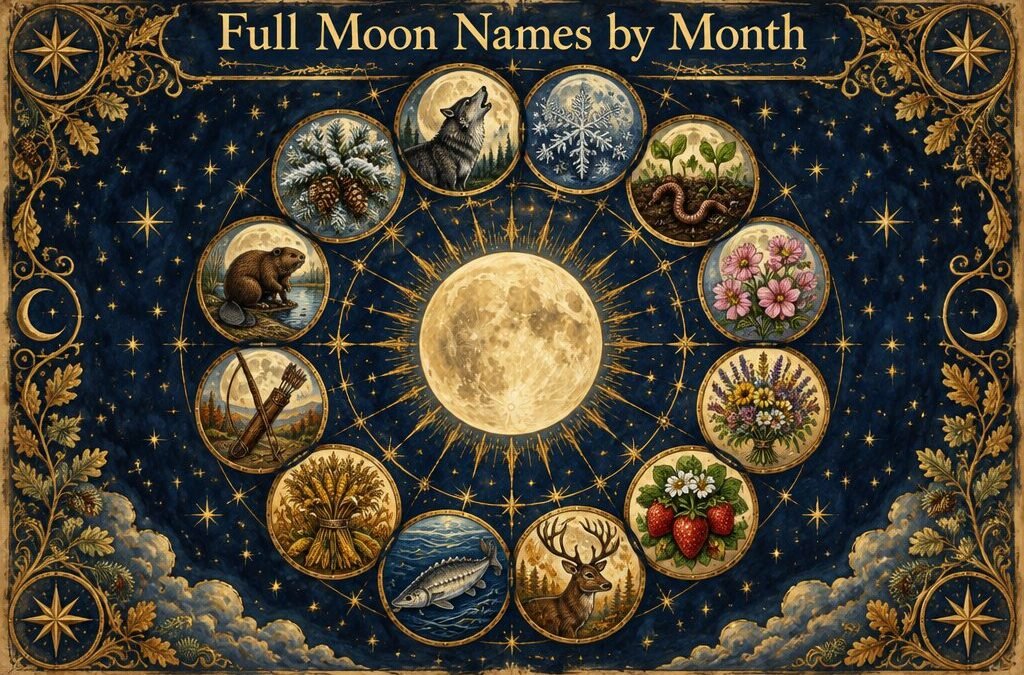
Long before calendars hung on walls, people tracked the year by the moon. Each full moon was given a name that described what was happening in nature at that time: wolves howling in deep winter, strawberries ripening in June, crops gathered in autumn. Many of the full moon names used today come from a mix of Native American, Colonial American and European traditions, popularized by publications such as the Old Farmer's Almanac. Here are the full moon names by month, what each one means, and its spiritual theme for rituals, intentions and tarot.
Full moon names at a glance
| Month | Full moon name | Other names | Spiritual theme |
|---|---|---|---|
| January | Wolf Moon | Ice Moon, Old Moon | Inner strength, community |
| February | Snow Moon | Hunger Moon, Storm Moon | Resilience, preparation |
| March | Worm Moon | Sap Moon, Crow Moon | Awakening, renewal |
| April | Pink Moon | Egg Moon, Sprouting Grass Moon | Growth, hope |
| May | Flower Moon | Milk Moon, Planting Moon | Abundance, beauty |
| June | Strawberry Moon | Rose Moon, Honey Moon | Love, sweetness, gratitude |
| July | Buck Moon | Thunder Moon, Hay Moon | Strength, ambition |
| August | Sturgeon Moon | Grain Moon, Red Moon | Harvest of effort, gratitude |
| September | Corn Moon or Harvest Moon | Barley Moon | Gathering, balance |
| October | Hunter's Moon | Blood Moon (seasonal name), Travel Moon | Preparation, intuition |
| November | Beaver Moon | Frost Moon, Mourning Moon | Preparation, letting go |
| December | Cold Moon | Long Night Moon, Oak Moon | Rest, reflection, endurance |
The Harvest Moon is the full moon closest to the autumn equinox, so it falls in either September or October. When it lands in September, October's full moon becomes the Hunter's Moon.
The full moons month by month
January: Wolf Moon
Named for the wolves heard howling in the cold, hungry depths of winter. The Wolf Moon is a time to reflect on your "pack," the people who support you, and on the instincts that guide you.
Theme: community, protection, trusting your instincts.
February: Snow Moon
Often the snowiest time of year in the Northern Hemisphere. The Snow Moon calls for resilience, patience and quiet preparation for spring.
Theme: endurance, self-care, planning.
March: Worm Moon
As the ground thaws, earthworms appear and birds return. The Worm Moon marks the stirring of new life.
Theme: awakening, fresh starts, clearing out the old.
April: Pink Moon
Named after pink spring wildflowers such as moss phlox. The moon is not actually pink, but the energy is full of blossoming hope.
Theme: growth, hope, emotional renewal.
May: Flower Moon
Flowers bloom in abundance. The Flower Moon celebrates beauty, fertility and creativity.
Theme: abundance, creativity, joy.
June: Strawberry Moon
The time of the strawberry harvest. With its sweetness and the warmth of early summer, it is linked to love and gratitude.
Theme: love, appreciation, celebrating relationships.
July: Buck Moon
Male deer grow new antlers at this time of year. The Buck Moon speaks of strength, confidence and pursuing goals.
Theme: ambition, self-belief, growth.
August: Sturgeon Moon
Named for the large sturgeon fish caught in the Great Lakes in late summer. It is a time to enjoy the rewards of your work.
Theme: gratitude, abundance, reaping what you sowed.
September: Corn Moon or Harvest Moon
The time of harvesting corn and other crops. Its bright light once allowed farmers to work late into the evening.
Theme: gathering, balance, completion.
October: Hunter's Moon
After the harvest, hunters prepared for winter by moonlight. The Hunter's Moon is about focus, preparation and intuition as the nights lengthen.
Theme: preparation, inner wisdom, setting priorities.
November: Beaver Moon
Beavers build their winter dams, and trappers once set traps before the waters froze. The Beaver Moon is about getting ready for winter and letting go of what you do not need.
Theme: preparation, release, gratitude.
The next Beaver Moon is on November 24, 2026.
December: Cold Moon
The long nights of winter arrive. Near the winter solstice, the Cold Moon is a time for rest, reflection and endurance.
Theme: rest, reflection, honoring the year.
The next Cold Moon is on December 24, 2026.
Special full moons
- Supermoon: a full moon near the moon's closest point to Earth, appearing slightly larger and brighter.
- Blue Moon: either the second full moon in one calendar month, or the third of four full moons in a season. Rare, hence "once in a blue moon."
- Blood Moon: a total lunar eclipse, when the moon turns red as it passes through Earth's shadow. (October's full moon is sometimes also called the Blood Moon as a seasonal name.)
- Micromoon: a full moon near the moon's farthest point, appearing slightly smaller.
Working with the full moon each month
The full moon is the peak of the moon cycle, ideal for gratitude, release and reflection. Try this simple monthly ritual:
- Light a candle and note which full moon it is.
- Reflect on its theme. What does the Wolf Moon's "community" or the Beaver Moon's "preparation" mean in your life right now?
- Write a gratitude list and a list of things you are ready to release.
- Pull a few tarot cards. A three-card full moon spread: What has come to light / What to release / What to celebrate. Draw it in our free Three Card Tarot reading.
- Cleanse your tools in the moonlight. Our guide to cleansing tarot cards covers moonlight and other methods.
For the meaning of every phase of the cycle, not just the full moon, read Moon Phases and Their Spiritual Meaning.
Frequently asked questions
What are the 12 full moon names?
The traditional full moon names are the Wolf Moon (January), Snow Moon (February), Worm Moon (March), Pink Moon (April), Flower Moon (May), Strawberry Moon (June), Buck Moon (July), Sturgeon Moon (August), Corn or Harvest Moon (September), Hunter's Moon (October), Beaver Moon (November) and Cold Moon (December).
Where do full moon names come from?
Most come from a mix of Native American, Colonial American and European traditions, describing seasonal events in nature. They were popularized by almanacs.
Is the Pink Moon actually pink?
No. The Pink Moon is named after pink spring flowers. It looks like any other full moon, although a moon near the horizon can appear golden or orange.
What is the difference between the Harvest Moon and the Hunter's Moon?
The Harvest Moon is the full moon closest to the autumn equinox. The Hunter's Moon is the full moon after it.
Follow the moons through the year
Each full moon carries the story of its season. Mark the next one in your calendar, reflect on its theme and let it guide a small ritual or reading. Between full moons, keep a daily touchpoint with our free Daily Tarot.