
Estimated reading time: 4 minutes
- The short answer
- Tarot vs oracle cards at a glance
- What are tarot cards?
- What are oracle cards?
- Which is better for beginners?
- How to use oracle cards
- Using tarot and oracle cards together
- What about the Yes No Oracle?
- Frequently asked questions
- Choose what speaks to you
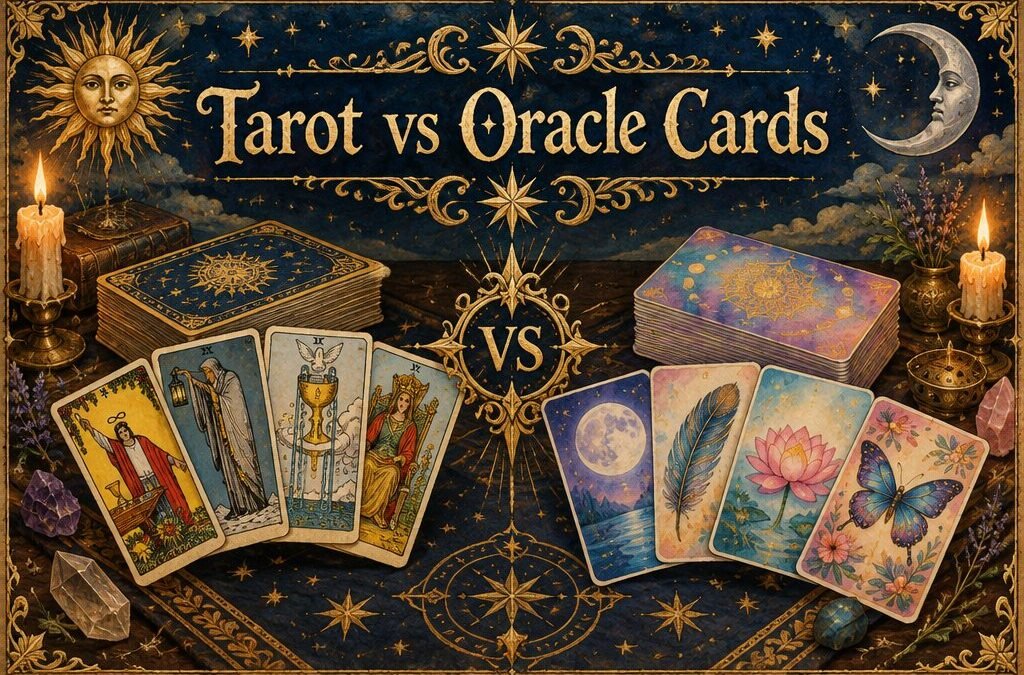
Walk into any spiritual shop and you will find two kinds of card decks side by side: tarot and oracle. They look similar, both are used for guidance and reflection, and many readers use both. But they work in very different ways. Tarot is a structured system with 78 cards and centuries of tradition; oracle decks are free-form, with as many cards and meanings as their creator chooses. Here is a clear comparison of tarot vs oracle cards, what oracle cards mean, which is better for beginners, and how to use them together.
The short answer
- Tarot cards follow a fixed structure: 78 cards divided into the 22 Major Arcana and 56 Minor Arcana, with established meanings shared across most decks.
- Oracle cards follow no fixed structure. Each deck has its own number of cards, themes and meanings, set by its creator.
Tarot vs oracle cards at a glance
| Tarot | Oracle | |
|---|---|---|
| Number of cards | 78 | Any (often 36 to 60) |
| Structure | Major and Minor Arcana, four suits | Decided by each deck |
| Meanings | Traditional, shared across decks | Unique to each deck |
| History | Since the 15th century (divination since the 18th) | Mostly modern |
| Learning curve | Steeper, but transferable | Gentle; read the guidebook |
| Tone | Covers the full range of life, including hard truths | Often gentle, uplifting, affirming |
| Best for | Detailed insight, complex questions | Inspiration, affirmation, themes |
What are tarot cards?
Tarot began as a card game in 15th-century Italy and became a tool for divination in the late 1700s. A tarot deck has:
- 22 Major Arcana cards, from The Fool to The World, representing major life lessons and turning points. Their sequence is known as the Fool's Journey.
- 56 Minor Arcana cards in four suits (Wands, Cups, Swords, Pentacles), covering everyday life. Learn about the suits in The Four Tarot Suits and Their Elements.
Because the structure is shared, once you learn tarot you can pick up almost any tarot deck and read it.
What are oracle cards?
Oracle cards are modern decks designed around a theme chosen by the creator: angels, goddesses, animals, crystals, the moon, affirmations, nature and more. Each card usually has a title or short message printed on it, and the guidebook explains the creator's intended meaning.
Because every oracle deck is different, there is no single "oracle card meaning." The Moon card in one oracle deck might mean intuition; in another it might mean rest. Always start with the deck's own guidebook, then add your intuition.
Which is better for beginners?
It depends on your goal.
Choose oracle cards if you want:
- Quick, uplifting messages with no study required.
- A gentle daily affirmation or theme.
- A deck that matches a specific interest, such as crystals or animals.
Choose tarot cards if you want:
- A complete system for exploring any question in depth.
- Readings that address challenges as well as encouragement.
- Skills that transfer to any tarot deck.
Many beginners start with an oracle deck for daily inspiration and add tarot when they are ready to learn. If you choose tarot, our guide to choosing your first tarot deck will help.
How to use oracle cards
- Read the guidebook to understand the deck's themes.
- Shuffle and ask a question, often an open one like "What do I need to know today?"
- Draw one to three cards. Oracle readings tend to be short.
- Read the message and notice your response. Oracle cards often speak through emotion and affirmation.
Some oracle decks include spreads in their guidebook; others leave it to you.
Using tarot and oracle cards together
Many readers combine the two:
- Theme card: draw one oracle card first to set the theme of a tarot reading.
- Clarifier: add an oracle card at the end of a tarot spread for extra insight or advice.
- Softener: when a tarot reading feels heavy, an oracle card can offer encouragement or a practical affirmation.
- Daily pairing: pull one tarot card and one oracle card each morning.
What about the Yes No Oracle?
The word "oracle" also describes any tool that gives answers. Our Yes No Oracle is a simple oracle: focus on a yes-or-no question, click the card for an answer, then talk it through with our reader. It is perfect for quick questions, while our tarot readings, such as One Card Tarot, use the full 78-card deck.
Frequently asked questions
What is the main difference between tarot and oracle cards?
Tarot has a fixed structure of 78 cards with traditional meanings shared across decks. Oracle decks have no fixed structure; each deck has its own number of cards and meanings.
Are oracle cards easier than tarot?
Usually, yes. Oracle cards often have their message printed on them and come with a guidebook, so you can start reading immediately. Tarot takes more study but offers a deeper, transferable system.
Can oracle cards predict the future?
Like tarot, oracle cards are best used for reflection, guidance and inspiration rather than predicting fixed events.
Can I use oracle cards with tarot?
Yes. Many readers add an oracle card to a tarot spread as a theme, clarifier or piece of advice.
Choose what speaks to you
There is no wrong choice between tarot and oracle cards; they are different tools for the same purpose: insight and reflection. Start with whichever excites you, and do not be surprised if you end up with both. Try a quick answer from our Yes No Oracle or a full tarot card from our free Daily Tarot.