
Estimated reading time: 5 minutes
- The Celtic Cross layout
- The 10 Celtic Cross positions
- Each position in detail
- How to connect the positions
- Example Celtic Cross reading
- Tips for reading the Celtic Cross
- Frequently asked questions
- Draw your own Celtic Cross
The Celtic Cross is the most famous tarot spread in the world. Popularized by A. E. Waite in 1910, it uses ten cards to give a layered picture of a situation: the heart of the matter, the influences around it, your inner state and where things are heading. It can look intimidating at first, but once you understand the Celtic Cross positions and how they connect, it becomes one of the most rewarding spreads to read. This guide explains all ten positions, how to read them together, and walks through an example.
The Celtic Cross layout
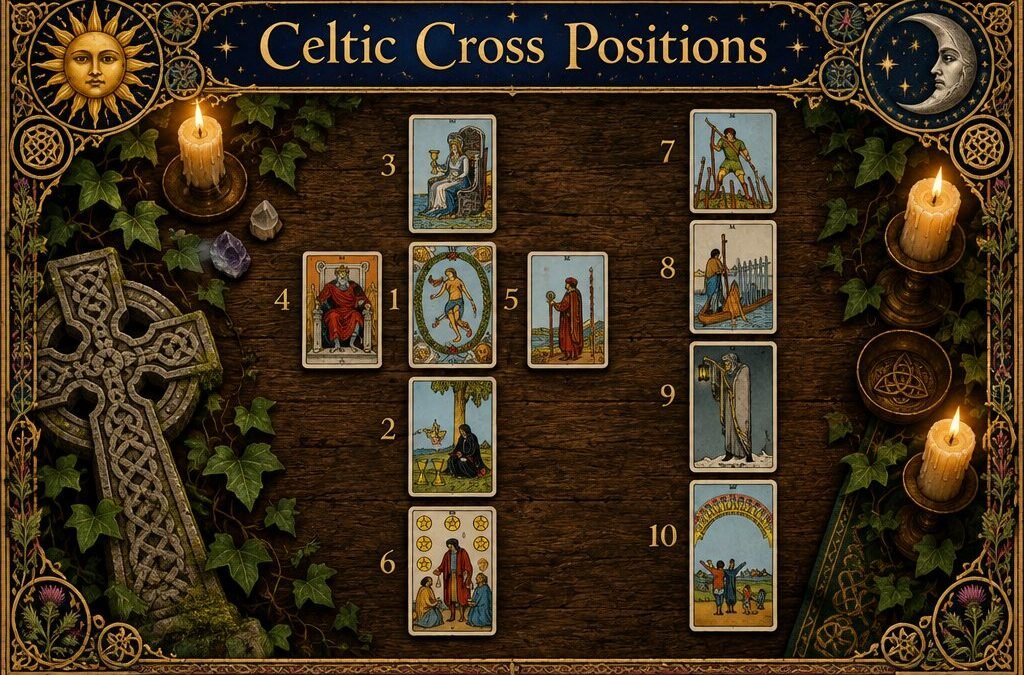
The spread has two parts: the cross (cards 1 to 6) on the left and the staff (cards 7 to 10) in a vertical column on the right.
- Card 1 sits in the center; card 2 lies sideways across it.
- Cards 3, 4, 5 and 6 surround them: below, left, above and right.
- Cards 7 to 10 are placed from the bottom of the staff to the top.
The 10 Celtic Cross positions
| Position | Name | Meaning |
|---|---|---|
| 1 | The present | The heart of the matter, your current situation |
| 2 | The challenge | What crosses you: the obstacle or tension |
| 3 | The foundation | The root cause or subconscious basis |
| 4 | The recent past | What is passing or leaving |
| 5 | The crown | Your conscious goal, or the best possible outcome |
| 6 | The near future | What is coming in the next weeks |
| 7 | Yourself | Your attitude and how you see yourself |
| 8 | External influences | Other people and the environment |
| 9 | Hopes and fears | What you hope for, or secretly fear |
| 10 | The outcome | Where things are heading on the current path |
Some readers swap positions 4 and 6, or 3 and 5. There is no single correct version; choose one and use it consistently.
Each position in detail
1. The present
The core of the reading. Everything else is read in relation to this card.
2. The challenge
Laid across card 1, this is the force that complicates the situation. Even a positive card here is read as a challenge: the Sun crossing you might suggest overconfidence or too much visibility.
3. The foundation
The roots of the situation, often something you are not fully conscious of. It explains why the present looks the way it does.
4. The recent past
An influence that is fading. It helps you see what you are moving away from.
5. The crown
Your conscious aim or the best you can achieve right now. Compare it with card 10: are your goals and your path aligned?
6. The near future
What is likely to come up soon, usually within a few weeks. It is a next step, not the final result.
7. Yourself
How you are approaching the situation. Court cards here often describe your own role or attitude. See Tarot Court Cards Explained.
8. External influences
Family, partners, colleagues, circumstances. This position reminds you what is outside your control.
9. Hopes and fears
Often the most emotionally honest card. Hopes and fears are frequently the same thing: we can fear what we most want.
10. The outcome
The likely result if things continue as they are. Read it as a trajectory, not a fixed fate.
How to connect the positions
The real skill in the Celtic Cross is reading the cards as a conversation:
- 1 and 2: the situation and its central tension.
- 3 and 5: what is underneath versus what you are aiming for.
- 4, 1 and 6: past, present and near future as a timeline.
- 7 and 8: you versus your environment.
- 9 and 10: whether your hopes or your fears are steering the outcome.
- 5 and 10: does the outcome match your goal? If not, look at card 7 for what you can change.
Also look at the whole spread: many Major Arcana cards suggest a significant turning point, a dominant suit shows which area of life is involved, and repeated numbers carry their own message, as explained in Tarot Numerology.
Example Celtic Cross reading
Question: "What do I need to know about my career change?"
- Present: Eight of Cups, walking away from something unfulfilling.
- Challenge: Four of Pentacles, fear of losing financial security.
- Foundation: The Hermit, a long period of soul-searching.
- Recent past: Ten of Wands, burnout from carrying too much.
- Crown: Ace of Pentacles, a new, solid opportunity.
- Near future: Knight of Wands, quick movement and enthusiasm.
- Yourself: Page of Pentacles, a willing beginner.
- External influences: Three of Pentacles, supportive collaborators.
- Hopes and fears: Wheel of Fortune, hoping for a lucky break and fearing the unknown.
- Outcome: Six of Wands, success and recognition.
Summary: burnout and reflection have prepared you to leave. Money fears are the main obstacle, but a practical opportunity, helpful people and your willingness to learn point toward success.
Tips for reading the Celtic Cross
- Ask an open question. It is too detailed for a simple yes or no.
- Write it down. Ten cards is a lot to hold in your head; a tarot journal helps.
- Read the story before the details. Get the overall impression first.
- Use the clarifier sparingly. If the outcome is unclear, draw one more card for advice.
- Treat jumper cards as part of the message, but do not let them derail the spread.
Frequently asked questions
What are the 10 positions of the Celtic Cross?
Present, challenge, foundation, recent past, crown, near future, yourself, external influences, hopes and fears, and outcome.
Is the Celtic Cross hard for beginners?
It is more complex than a three-card spread, but learning it position by position makes it manageable. Many beginners start with the six-card cross before adding the staff.
Which card is the most important in the Celtic Cross?
Cards 1 and 2 form the heart of the reading, while card 10 shows the likely outcome. All positions matter, but the reading revolves around the central cross.
Can I read the Celtic Cross for myself?
Yes. It is one of the best spreads for self-reflection. Our guide to reading tarot for yourself has tips for staying objective.
Draw your own Celtic Cross
The best way to learn the Celtic Cross positions is to practice. Try our free Celtic Cross Tarot reading, which lays out all ten cards with the meaning of each position.