
Estimated reading time: 4 minutes
- What is a jumper card?
- Do jumper cards mean anything?
- How to read a jumper card
- Should a jumper go into the spread?
- When the same card keeps jumping
- Common jumper cards and what they might say
- How to reduce jumpers (if you want to)
- Frequently asked questions
- Catch the message
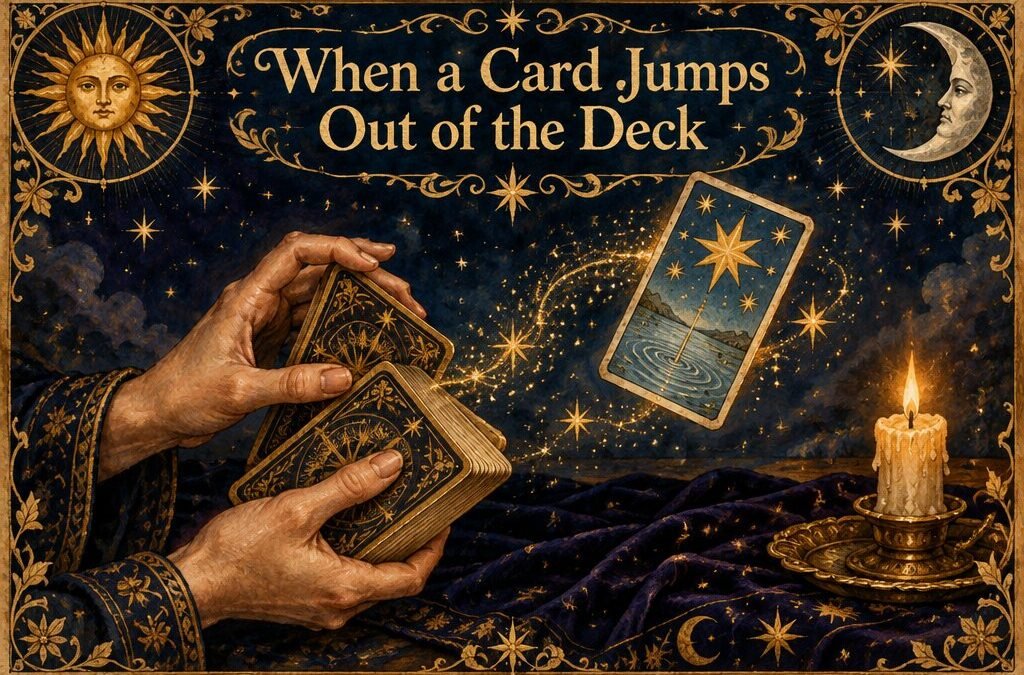
You are shuffling, focused on your question, and suddenly a card leaps out of the deck and lands on the table, sometimes face up, sometimes face down, sometimes on the floor. Every tarot reader knows the moment. These are called jumper cards (or "jumping cards"), and many readers treat them as special messages that want to be seen. Others see them as nothing more than a slippery shuffle. Here is what it means when a tarot card jumps out of the deck, how to read jumper cards, and what to do when the same card keeps appearing.
What is a jumper card?
A jumper card is any card that falls or flies out of the deck while you are shuffling, before you deliberately draw. It can happen with any shuffling method, though it is most common with the overhand shuffle and with new, stiff or slippery decks.
Do jumper cards mean anything?
Readers fall into three camps:
- It is a message. Many believe a jumper card is your intuition, your guides or the universe insisting that you pay attention. The card has "jumped the queue."
- It depends on how it feels. Some readers check in with their gut: if the card feels significant, they read it; if not, they put it back.
- It is just physics. Others see jumpers as an accident of shuffling and return them to the deck without a second thought.
There is no single correct approach. Choose a rule that suits you and apply it consistently, so you are not tempted to keep only the jumpers you like.
How to read a jumper card
If you choose to read jumpers, here are common ways to interpret them:
- As the theme of the reading. The jumper sets the tone, and the spread fills in the details.
- As a direct answer. Some readers treat a jumper as the core answer to the question, with the spread adding context.
- As advice. The jumper is what you most need to know or do right now.
- As something overlooked. The card highlights an issue or energy you have been ignoring.
Face up or face down?
Some readers read only jumpers that land face up, since those have "shown themselves." Others read all jumpers, whatever their orientation. If a jumper lands upside down from your point of view, you can read it reversed, or simply upright if you do not use reversals. Our guide to reversed tarot cards explains the difference.
More than one jumper
If two or three cards jump together, read them as a pair or trio, as you would a short spread. Their relationship often carries the message.
Should a jumper go into the spread?
Readers handle this in different ways:
| Approach | How it works |
|---|---|
| Read it, then return it | Note the message, put the card back and continue shuffling |
| Place it first | The jumper becomes card one or a "theme card" above the spread |
| Keep it aside | Read the spread, then read the jumper as a final clarifier |
| Ignore it | Return it to the deck; only deliberately drawn cards count |
When the same card keeps jumping
If the same card jumps out again and again, across days or readings, many readers take it as a strong signal. Ask yourself:
- What is this card's core message, and where does it apply in my life?
- What am I avoiding that this card might be pointing to?
- Is this card describing a person, an energy or a lesson?
Write it down in your tarot journal each time. Patterns often become clear when you look back over a few weeks.
Common jumper cards and what they might say
- The Tower: change is coming whether you are ready or not.
- The Star: hold on to hope; healing is on its way.
- Death: a chapter is ending; allow it.
- The Lovers: a meaningful choice or relationship needs your attention.
- Ace of Pentacles: do not miss a practical opportunity.
How to reduce jumpers (if you want to)
If jumpers happen so often that they distract you:
- Shuffle closer to the table or over a soft cloth.
- Hold the deck more firmly and move smaller packets of cards.
- Try the wash shuffle, which keeps cards on the table.
- Break in a new deck by handling it often until it softens.
Our guide on how to shuffle tarot cards covers five methods.
Frequently asked questions
What does it mean when a tarot card falls out?
Many readers believe a card that falls out while shuffling carries an important message, often the theme or answer of the reading. Others see it as an accident. Decide on your own approach and apply it consistently.
Should I read a card that falls on the floor?
That is up to you. Some readers treat a card on the floor as a jumper and read it; others simply return it to the deck.
Are jumper cards more important than the spread?
Not necessarily. Many readers use a jumper as the theme or a clarifier, and read the spread as the main reading.
Why does the same tarot card keep jumping out?
A repeating jumper is often read as a strong message that you have not yet acted on. Reflect on its meaning and where it applies in your life right now.
Catch the message
Whether you see jumper cards as messages or happy accidents, they are a fun part of tarot. Choose your rule, stay consistent and notice the patterns. Then draw your card deliberately with our free One Card Tarot reading and see whether it echoes your jumper.