
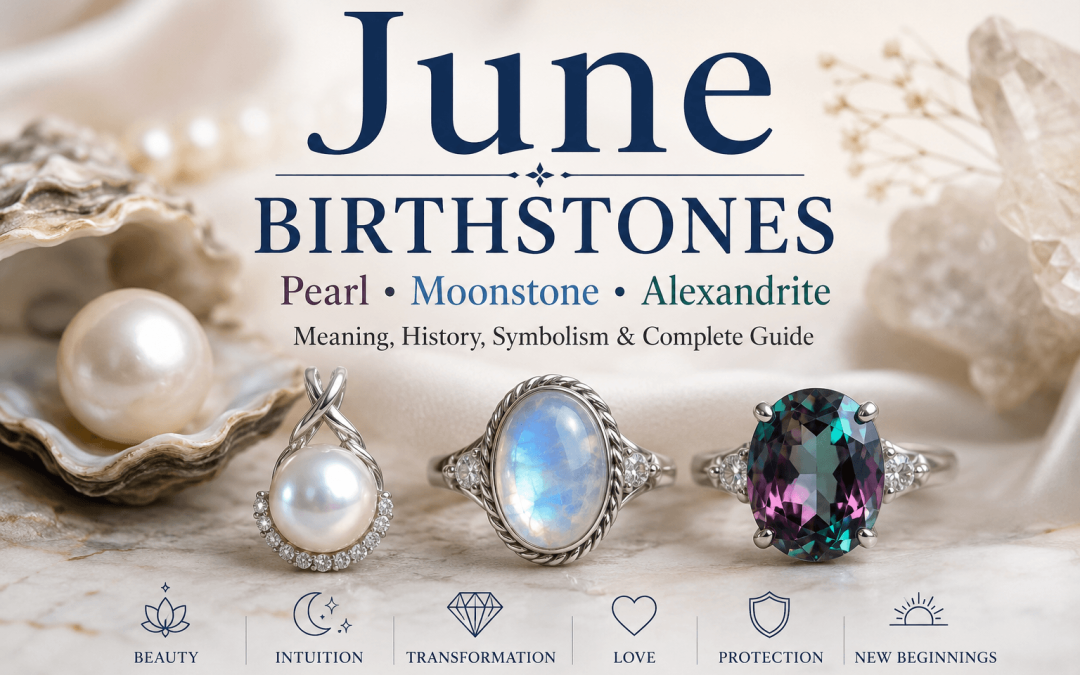
June Birthstone Overview
June is one of only a few months with three official birthstones, making it especially unique among the birth months. People born in June can choose between the timeless elegance of pearl, the mystical glow of moonstone, and the rare color-changing beauty of alexandrite.
Each gemstone has its own fascinating history, symbolism, appearance, and value. Whether you're looking for a meaningful birthday gift, buying jewelry, or simply curious about birthstones, understanding the differences between these three gems can help you make the right choice.
Unlike most birth months that have a single representative gemstone, June offers options for every style and budget—from classic organic pearls to magical moonstones and one of the world's rarest gemstones, alexandrite.
What Is the June Birthstone?
The official June birthstones are:
- Pearl
- Moonstone
- Alexandrite
Pearl is the traditional and most widely recognized June birthstone. Moonstone was later added because of its growing popularity and symbolic connection to intuition and feminine energy. Alexandrite became an official alternative due to its remarkable rarity and unique optical properties.
Each stone represents different qualities while sharing themes of transformation, wisdom, emotional balance, and personal growth.
Why Does June Have Three Birthstones?
Many people wonder why June has more birthstones than other months.
Originally, birthstone lists varied by culture, religion, and region. During the early 20th century, jewelry organizations worked to standardize birthstones. As gemstones became more accessible and consumer preferences evolved, additional birthstones were added for several months.
June received three birthstones because:
- Pearls are organic rather than mineral gemstones.
- Moonstone provides an affordable mineral alternative.
- Alexandrite offers a rare premium gemstone option.
Today, this variety allows people to select a birthstone that matches their personality, budget, and preferred jewelry style.
Pearl: The Traditional June Birthstone
Pearls have symbolized elegance and sophistication for thousands of years. Unlike most gemstones that form underground, pearls develop naturally inside oysters and mollusks.
Natural pearls are extremely rare, while cultured pearls dominate today's jewelry market.
How Pearls Form
A pearl begins when a tiny irritant enters an oyster or mollusk. The animal responds by coating the object with layers of nacre, eventually creating a smooth, lustrous pearl over several years.
Modern cultured pearls follow the same natural process with careful human assistance.
Types of Pearls
Several pearl varieties are available:
Freshwater Pearls
Freshwater pearls are among the most affordable options and come in numerous shapes, colors, and sizes. They are primarily cultivated in lakes and rivers.
Akoya Pearls
Akoya pearls are famous for their perfectly round shape and exceptional luster. They are considered the classic pearl used in traditional necklaces.
South Sea Pearls
South Sea pearls are among the largest and most valuable pearls. They often display luxurious white, silver, or golden hues.
Tahitian Pearls
Known for their naturally dark colors, Tahitian pearls range from black to green, blue, purple, and charcoal tones.
Pearl Meaning and Symbolism
For centuries, pearls have represented:
- Purity
- Wisdom
- Honesty
- Integrity
- Peace
- Loyalty
- Emotional balance
- Inner beauty
Many cultures believe pearls encourage calmness and help people make wise decisions during challenging situations.
Because they develop slowly over time, pearls also symbolize patience and personal growth.
Pearl Colors
Although white pearls are the most famous, pearls naturally occur in many colors:
- White
- Cream
- Silver
- Gold
- Pink
- Lavender
- Peach
- Black
- Green
- Blue
- Gray
The color depends on the oyster species, water conditions, and environmental factors.
Pearl Hardness and Durability
Pearls are relatively soft gemstones.
On the Mohs Hardness Scale, pearls rank approximately 2.5–4.5, making them more susceptible to scratches than most gemstones.
Because of their softness, pearls require gentle care and should be stored separately from harder jewelry.
Moonstone: The Mystical June Birthstone
Moonstone belongs to the feldspar mineral family and is admired for its enchanting glow known as adularescence.
As light moves across the stone, it creates a floating blue or white shimmer that resembles moonlight.
This mesmerizing optical effect has fascinated civilizations for thousands of years.
Moonstone Meaning
Moonstone is commonly associated with:
- New beginnings
- Intuition
- Emotional healing
- Inner peace
- Feminine energy
- Love
- Inspiration
- Spiritual growth
Many traditions consider moonstone a gemstone of emotional balance and positive transformation.
Moonstone Colors
Moonstones appear in several beautiful colors:
- White
- Colorless
- Peach
- Gray
- Blue
- Rainbow
- Green
- Brown
The most valuable moonstones typically feature a vivid blue sheen over a transparent body.
Moonstone Hardness
Moonstone measures approximately 6–6.5 on the Mohs Hardness Scale.
It is significantly more durable than pearl but still requires careful handling to prevent chips and scratches.
Alexandrite: The Rare June Birthstone
Alexandrite is among the rarest and most valuable gemstones in the world.
Its most remarkable characteristic is its dramatic ability to change color under different lighting conditions.
In daylight, alexandrite usually appears green or bluish-green.
Under incandescent lighting, it shifts to reddish-purple or raspberry red.
This phenomenon is known as the alexandrite effect.
Why Alexandrite Changes Color
Alexandrite contains trace amounts of chromium.
Chromium selectively absorbs different wavelengths of light, causing the gemstone to display dramatically different colors depending on the surrounding light source.
Very few gemstones exhibit such a striking optical phenomenon.
Alexandrite Symbolism
Alexandrite often symbolizes:
- Good fortune
- Prosperity
- Confidence
- Adaptability
- Creativity
- Luck
- Intelligence
- Transformation
Its changing appearance makes it a powerful symbol of flexibility and embracing life's transitions.
Alexandrite Hardness
Alexandrite scores approximately 8.5 on the Mohs Hardness Scale.
Its excellent durability makes it ideal for rings, bracelets, necklaces, and everyday jewelry.
June Birthstone Color Meanings
Each June birthstone offers its own distinctive color symbolism.
Pearl
Represents purity, innocence, honesty, elegance, and timeless beauty.
Moonstone
Represents mystery, intuition, serenity, and emotional harmony.
Alexandrite
Represents transformation, strength, adaptability, and prosperity.
June Birthstone History
Ancient Pearls
Pearls were treasured by ancient Egyptians, Romans, Greeks, Persians, Indians, and Chinese civilizations.
Royal families often viewed pearls as symbols of wealth and divine favor.
Some of the earliest pearl jewelry dates back over 5,000 years.
Moonstone Through History
Ancient Romans believed moonstones were formed from solidified moonlight.
In India, moonstone has long been considered sacred and associated with love and protection.
During the Art Nouveau period, moonstone became one of the most popular gemstones in artistic jewelry.
Discovery of Alexandrite
Alexandrite was discovered in Russia's Ural Mountains during the 19th century.
It was named after the future Tsar Alexander II.
Because its green and red colors matched the military colors of Imperial Russia, alexandrite quickly became a national treasure.
June Birthstone Spiritual Meaning
Many people associate June birthstones with emotional and spiritual growth.
Pearls are believed to encourage wisdom and calmness.
Moonstones are linked to intuition, emotional healing, and spiritual awareness.
Alexandrites are thought to inspire confidence, resilience, and positive transformation.
Although these meanings have deep cultural roots, they are symbolic traditions rather than scientifically proven properties.
June Birthstone Zodiac Connections
June includes two zodiac signs.
Gemini (May 21 – June 20)
Geminis often appreciate alexandrite's adaptability and moonstone's creativity.
Cancer (June 21 – July 22)
Cancer personalities frequently connect with pearls because of their nurturing symbolism and emotional depth.
June Birthstone Jewelry
All three June birthstones are popular choices for jewelry.
Popular options include:
- Engagement rings
- Pendants
- Earrings
- Bracelets
- Necklaces
- Anniversary gifts
- Birthstone rings
Pearls are especially popular in classic necklaces, while alexandrite is highly sought after in luxury engagement rings due to its rarity.
Moonstone has become increasingly fashionable in contemporary and bohemian jewelry designs.
How to Choose the Best June Birthstone
The ideal June birthstone depends on personal preferences.
Choose pearl if you appreciate timeless elegance, tradition, and classic sophistication.
Choose moonstone if you enjoy mystical beauty, soft glowing colors, and symbolic meaning.
Choose alexandrite if you're looking for rarity, exceptional durability, and one of the world's most fascinating gemstones.
June Birthstone Care Guide
Caring for Pearls
- Wipe with a soft cloth after wearing.
- Avoid perfumes and cosmetics.
- Keep away from harsh chemicals.
- Store separately from harder gemstones.
- Never use ultrasonic cleaners.
Caring for Moonstone
- Clean with warm water and mild soap.
- Avoid sudden impacts.
- Store individually.
- Keep away from abrasive materials.
Caring for Alexandrite
- Wash with warm water and gentle soap.
- Dry with a soft microfiber cloth.
- Store separately to prevent scratching other gemstones.
- Professional cleaning is recommended for valuable pieces.
June Birthstone Gift Ideas
June birthstones make thoughtful gifts for many occasions, including:
- Birthdays
- Anniversaries
- Graduations
- Weddings
- Mother's Day
- Push presents
- Milestone celebrations
Personalized birthstone jewelry adds sentimental value while creating a lasting keepsake.
June Birthstone FAQs
What is the official June birthstone?
June has three official birthstones: pearl, moonstone, and alexandrite.
Why does June have three birthstones?
The month has multiple birthstones to provide traditional, modern, and luxury alternatives that suit different preferences and budgets.
Which June birthstone is the rarest?
Alexandrite is one of the rarest gemstones in the world and is considerably rarer than pearls or moonstones.
What color is the June birthstone?
June birthstones appear in many colors. Pearls come in white, black, gold, pink, and other shades. Moonstones can be white, blue, peach, gray, or rainbow. Alexandrite changes from green in daylight to red under warm indoor lighting.
Is pearl a real gemstone?
Yes. Although pearls are organic rather than mineral gemstones, they are officially recognized as genuine gemstones and remain the traditional June birthstone.
Which June birthstone is best for everyday wear?
Alexandrite is the most durable choice for everyday jewelry because of its high hardness. Moonstone offers moderate durability, while pearls require the most careful handling.
Are cultured pearls real pearls?
Yes. Cultured pearls are genuine pearls formed naturally by oysters with human assistance during the cultivation process.
Can someone born in June wear all three birthstones?
Absolutely. Many people combine pearl, moonstone, and alexandrite into a single piece of jewelry or choose different birthstones for different occasions.
Interesting Facts About June Birthstones
- June is one of the few months with three official birthstones.
- Pearls are the only birthstones created by living organisms.
- Alexandrite can appear green, blue-green, purple, or red depending on lighting.
- Fine alexandrite is often more valuable per carat than many diamonds.
- Moonstone's glowing appearance is caused by light scattering inside its crystal layers.
- Pearls have been treasured for more than 5,000 years.
- Natural pearls are exceptionally rare in modern times.
- Rainbow moonstone is technically a variety of labradorite but is commonly sold as moonstone in jewelry.
Final Thoughts
The June birthstone collection is unlike any other. Whether you're drawn to the timeless elegance of pearl, the ethereal glow of moonstone, or the extraordinary color-changing brilliance of alexandrite, each gemstone tells its own story.
These three birthstones offer a rare combination of beauty, symbolism, and history, giving June-born individuals exceptional flexibility when selecting meaningful jewelry. Understanding their origins, characteristics, symbolism, durability, and care requirements helps you choose the perfect gemstone for yourself or someone special while appreciating the remarkable diversity that makes June one of the most distinctive birthstone months.